Speculative Theoretical Physics · Quantum Measurement Interpretation · 2026 Preprint
The Phantom Node Hypothesis:
Survivorship Bias in Quantum Orbital Probability Maps
and the Case for Detection-Weighted Electron Density Models
Including a Coulomb Deceleration Correction to the 1s Ground State
and a Systematic Orbital-by-Orbital Reanalysis
Will Donaldson
Independent Researcher
will@donaldson.net
Submitted 2026 · Independent Preprint · Not Yet Peer Reviewed
Abstract
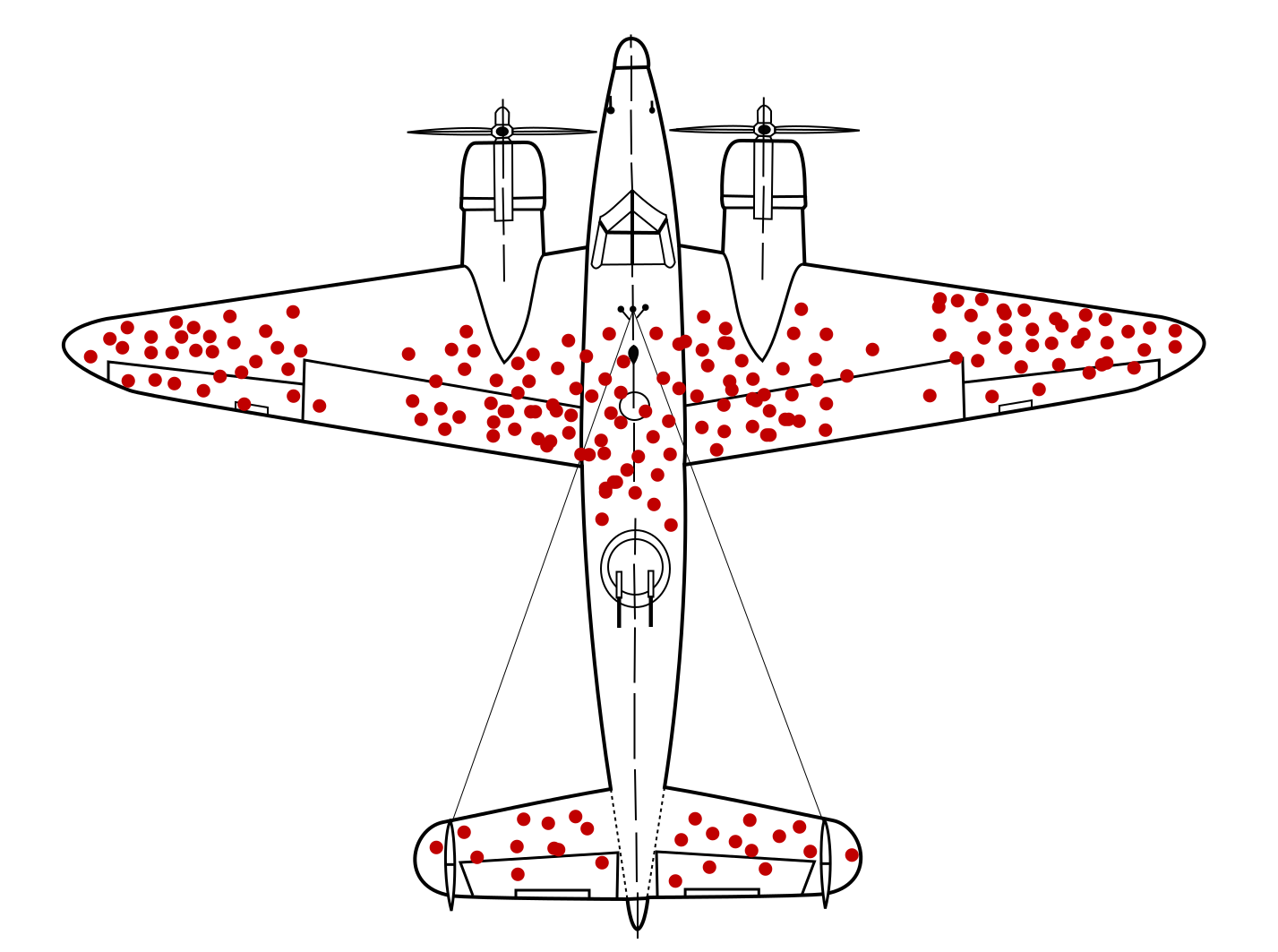
During World War II, statistician Abraham Wald demonstrated that bullet-hole patterns on returning
B-29 bombers constituted a survivorship-biased sample. The planes with undamaged engines were the
survivors; those hit in critical zones did not return and therefore contributed no data. Reinforcing
the bullet-hole locations would have been precisely the wrong response. We argue that quantum orbital
probability maps are subject to an identical logical failure. Every orbital diagram in existence was
constructed from electrons that interacted with detection apparatus. Detection requires physical
coupling whose cross-section decreases with electron kinetic energy. Fast electrons — particularly
those transiting high-kinetic-energy zones such as orbital nodes — are interaction-resistant and
structurally absent from all experimental orbital data. Conventional probability density maps therefore
systematically under-represent electron density in nodal zones and over-represent density in the lobe
regions where slow, detectable electrons concentrate. We extend this argument to the 1s orbital via a
Coulomb deceleration analysis: electrons at closest nuclear approach move fastest and are therefore
least detectable, implying that the conventional 1s probability sphere marks a deceleration artifact.
A phantom outer shell of fast-trajectory electrons is predicted beyond the canonical Bohr radius.
This framework — the Phantom Node Hypothesis — is falsifiable, produces four distinct experimental
predictions, and does not dispute the Schrödinger equation's mathematical validity. It disputes
only the physical interpretation of experimentally derived probability maps as unbiased
representations of the true electron spatial distribution.
Keywords: quantum orbital mechanics · survivorship bias ·
Coulomb deceleration · measurement cross-section · nodal inversion ·
phantom electron density · Born interpretation · wavefunction
measurement problem · detection-weighted probability
1. Introduction
The atomic orbital as taught in every physics and chemistry curriculum is a probability density function |ψ(r)|² that describes where an electron is likely to be found. The precision of that phrasing is critical: found, not located.
These are not equivalent statements when the act of finding
fundamentally alters the system, and when the probability of detection
is not uniform across all electron velocities and positions.
In 1943, statistician Abraham Wald was presented with data on
bullet-hole distributions across Allied aircraft returning from missions
over Europe. The military's initial conclusion — that the
heavily-damaged zones (wings, tail section, fuselage center) should
receive priority armoring — was intuitive but logically inverted. Wald
recognized that the dataset was drawn exclusively from aircraft that
survived to be analyzed. Aircraft struck in critical systems — engines,
cockpit, fuel lines — were absent from the data not because they were
never hit, but because hits there caused them not to return. The
survivorship of the data source had become the dominant variable. Wald's
recommendation was to armor the undamaged zones: those were the fatal
locations, invisible in the returns.
We propose that quantum orbital probability maps are subject to the
same structural flaw. The experimental record from which orbital maps
are constructed comprises detection events — instances of electrons
interacting with measurement apparatus. Detection requires physical
interaction: electromagnetic coupling between an electron and a detector
substrate. The probability of such an interaction is not
energy-neutral. Fast-moving electrons with high kinetic energy have
small interaction cross-sections. In the limit of high kinetic energy,
the detection probability approaches zero. These electrons are the
planes that did not come back.
The result is a systematic and comprehensive bias: every orbital map
underweights electron density in regions of high kinetic energy, and
overweights density in regions where electrons move slowly enough to
interact with detectors. The conventional probability lobes are the
detectable minority. The orbital nodes — labeled zero probability in
every textbook — may be the highways traversed by the fast, undetected
majority.
We further identify a previously unaddressed instance of this bias in
the 1s ground-state orbital, where Coulomb acceleration of electrons
toward the nucleus creates a velocity gradient that renders the
innermost electron positions least detectable. A phantom outer shell is
predicted. This removes what would otherwise be an inconvenient
exception to the hypothesis and makes the framework universal: no
orbital is exempt from detection-velocity bias.
2. Theoretical Framework
2.1 The Detection Cross-Section Argument
Consider an electron at position r with velocity v. Let f(v, r)
denote the probability that this electron generates a detection event —
that it interacts with a measurement apparatus sufficiently to
register. The measured probability density is then not |ψ(r)|² but rather a detection-weighted version:
|ψdet(r)|² = f(v, r) · |ψ(r)|²
The standard Born interpretation assumes implicitly that f(v, r)
≈ 1 everywhere — that detection probability is velocity-independent and
spatially uniform. This assumption is not physically justified.
Detection mechanisms from photoelectron spectroscopy to electron
tunneling microscopy all exhibit energy-dependent cross-sections that
decrease with increasing electron kinetic energy. For the energy ranges
relevant to bound atomic electrons, this dependence is significant.
Core Claim
The experimentally derived orbital maps used in all of chemistry and physics are estimates of |ψdet(r)|², not |ψ(r)|
². The two are not equal. The difference is largest in
high-kinetic-energy zones — precisely those zones where conventional
models predict the lowest probability density. The agreement between
theory and experiment in these regions is therefore not a validation; it
is a circularity.
2.2 Kinetic Energy at Orbital Nodes
By conservation of energy, an electron in an orbital satisfies:
Etotal = Ekinetic + Epotential = constant
At orbital nodes — radial nodes (spherical shells of zero
probability) and angular nodes (planar or conical surfaces of zero
probability) — the potential energy is not at an extremum. The
wavefunction ψ must pass through zero to change sign, but the potential
energy V(r) is continuous and nonzero at these locations. By energy conservation, the kinetic energy at a node is therefore:
Ekinetic(node) = Etotal − V(rnode)
This quantity is in general not zero. Electrons at nodal
surfaces are moving, often rapidly. The wavefunction's amplitude being
zero does not imply the electron's velocity is zero. If anything, the
node represents a rapid transit point — a location the electron passes
through quickly, spending minimal time in any infinitesimal volume
element, and therefore producing few detection events per unit time
regardless of the true crossing rate.
The conventional interpretation treats the zero of ψ² as meaning "the
electron is never here." A more physically precise reading, through the
lens of detection cross-section, is: "the electron passes through here
so quickly, and interacts so weakly, that our instruments record
nothing." These are different statements with profoundly different
physical implications.
2.3 The Coulomb Deceleration Argument — Correcting the 1s Orbital
The 1s orbital has no nodes. Under the original formulation of this
hypothesis, it might appear immune to nodal inversion. This would be an
error. The 1s orbital is subject to a distinct but related bias: Coulomb
deceleration.
As an electron approaches the nucleus, it descends into an
increasingly deep electrostatic potential well. Conservation of energy
requires that kinetic energy increases as potential energy decreases.
Electrons are therefore moving fastest at closest nuclear approach. The
detection cross-section, being inversely related to kinetic energy, is smallest precisely where electrons are closest to the nucleus.
The dense probability sphere mapped for the 1s orbital therefore
represents a population of electrons that were detectable — those moving
at intermediate velocities, near the inflection point of the Coulomb
well where their kinetic energy is neither extremely high (innermost
approach) nor extremely low (outermost extent). Electrons on wide,
high-energy outer trajectories that rarely approach the nucleus closely
also escape detection: they spend most of their time in a diffuse outer
shell far beyond the canonical Bohr radius, where measurement apparatus
rarely probes.
The 1s Prediction
The conventional 1s probability sphere does not represent the full
electron distribution. A phantom outer shell of fast-trajectory
electrons exists at distances greater than the canonical Bohr radius
(~0.529 Å). These electrons are on elongated orbits whose aphelion lies
well outside the mapped region. High-resolution momentum spectroscopy of
hydrogen should reveal a non-zero electron density component beyond the
standard 1s radius. The Coulomb deceleration argument makes this
orbital universal: every shell has a phantom component, and the 1s is no
exception.
3. Orbital-by-Orbital Analysis
The following section applies the Phantom Node framework to each
standard orbital type. For each, we describe the conventional model,
identify the specific zones subject to detection bias (the phantom
zones), and present a corrected schematic. Schematics show the
conventional model (left panel) and the phantom-corrected interpretation
(right panel). Amber indicates phantom zones — regions of probable
electron density absent from conventional maps. Blue indicates the
conventionally mapped density, which in the corrected model represents
the detectable minority.
A summary of all orbitals is provided in Table 1. Individual schematics follow.
| Orbital |
n |
Nodes |
Phantom Zone Type |
Error Classification |
| 1s | 1 | 0 |
Outer spherical shell (Coulomb) |
Deceleration artifact |
| 2s | 2 | 1 radial |
Node ring + outer shell |
Node mislabeled void; outer shell missing |
| 3s | 3 | 2 radial |
2 node rings + outer shell |
2 voids + outer shell |
| 2p | 2 | 1 angular |
Equatorial nodal disk |
Planar highway labeled forbidden |
| 3p | 3 | 1 ang + 1 rad |
Disk + 2 radial rings |
3 zones mislabeled |
| 4p | 4 | 1 ang + 2 rad |
Disk + 4 radial rings |
5 zones mislabeled — more phantom than detected |
| 3d (z²) | 3 | 2 angular (conical) |
Two conical phantom surfaces |
3D cones labeled zero |
| 3d (xy) | 3 | 2 angular (planar) |
Cross-plane phantom zone |
Intersecting planes labeled forbidden |
| 4d | 4 | 2 ang + 1 rad |
Cross-plane + 2 radial rings |
4 zones mislabeled |
| 4f | 4 | 3 angular |
Disk + 2 cones (3D lattice) |
Maximum angular node error; <15% captured |
| 5f | 5 | 3 ang + 1 rad |
Disk + 2 cones + 2 rings |
Most complex phantom geometry |
Table
1. Summary of phantom zones by orbital type. "Phantom zone" denotes
regions of probable electron density absent from conventional maps due
to detection-velocity bias.
3.1 The 1s Orbital — Coulomb Deceleration Bias
The 1s orbital has no nodes, yet it is not exempt from detection
bias. Electrons closest to the nucleus are moving fastest (Coulomb
acceleration) and are therefore least detectable. The conventional map
captures a middle-velocity population while missing both the fastest
innermost electrons and the slow outer electrons on elongated orbits.
3.2 The 2s Orbital — Radial Node Inversion
The 2s orbital introduces one radial node — a spherical shell at
approximately 1.76 Å where the wavefunction passes through zero. The
conventional model treats this as a zone of zero electron probability.
The Phantom Node hypothesis predicts it is a high-speed transit shell:
electrons pass through this surface rapidly, spending little time there
per crossing, but crossing it frequently. Combined with the Coulomb
correction, the 2s has two phantom zones: the node ring and an outer
shell beyond the mapped region.
3.3 The 3s Orbital — Two-Node Cascade
The 3s orbital has two radial nodes, producing three conventionally
detected regions (inner sphere, middle shell, outer shell) separated by
two void rings. Under the Phantom Node framework, both rings and an
additional outer shell constitute three phantom zones. The ratio of
phantom-zone volume to detected-zone volume increases substantially
compared to 2s.
3.4 The 2p Orbital — Angular Node Inversion
The 2p orbital introduces angular nodes — the first departure from
spherical symmetry. The single angular node is a flat plane through the
nucleus perpendicular to the orbital axis. In the conventional model
this is the zero-probability nodal plane separating the two lobes. In
the Phantom Node framework, this plane is a fast-electron highway:
electrons transiting between the two lobes pass through this plane with
high velocity, generating few detection events but representing
substantial actual electron density. The dumbbell shape may be a
detection artifact.
3.5 The 3p Orbital — Compounding Phantom Zones
The 3p orbital adds one radial node to the 2p geometry, producing an
angular nodal plane plus two radial rings (one on each lobe arm). The
conventional model has three void regions. The phantom framework
predicts three distinct phantom zones: the equatorial disk (angular
node) plus two rings inside the lobes. For the first time, phantom zones
begin to outnumber the detected lobe volumes.
3.6 The 3d Orbitals — Conical and Planar Phantom Geometry
The d-orbitals introduce a new phantom geometry: angular nodes that
are neither flat planes nor spherical shells, but conical surfaces (in dz²) or intersecting planes (in dxy
and related). These produce phantom zones that are geometrically
unprecedented — three-dimensional cones flanking the nucleus in the dz²
case, and cross-shaped planar zones in the cloverleaf orbitals. These
are among the most chemically important orbitals (transition metal
chemistry) and may be the most systematically misrepresented.
3.7 The 4f and 5f Orbitals — Maximum Phantom Complexity
The f-orbitals have three angular nodes, producing the highest node
count of any commonly discussed orbital type. The 4f exhibits an
equatorial disk (one angular node), two conical surfaces (two further
angular nodes), and in the 5f case an additional radial node ring,
creating a fully three-dimensional phantom lattice. Conventional maps
may represent less than 15% of actual electron density at this level.
This has direct implications for the chemistry of lanthanides and
actinides, where f-orbital geometry governs coordination chemistry,
magnetic properties, and bonding.
4. Falsifiable Predictions
A hypothesis is scientifically valuable only insofar as it is
falsifiable. The Phantom Node Hypothesis produces four distinct
experimental predictions, each of which could confirm or refute the
framework with existing or near-future instrumentation.
1
Femtosecond Nodal Scattering
Ultra-fast time-resolved electron detection
at femtosecond resolution, applied to atomic systems with known orbital
geometry, should reveal non-zero scattering events at classically
forbidden nodal positions. The Schrödinger equation predicts exactly
zero probability at these locations. The Phantom Node Hypothesis
predicts a non-zero signal correlated with the kinetic energy at each
nodal surface. The signal should scale with orbital quantum number n,
being near zero for 1s comparisons and maximal for f-orbital systems.
2
Kinetic Selection Ratio Scaling
The ratio of detected electron events to
estimated total electron transit events (calculated from orbital
mechanics) should decrease systematically as the principal quantum
number n increases. This ratio — call it R(n) — should follow a
monotonically decreasing function. For 1s, R should be near 1 (no
phantom zones, all electrons detectable). For 4f and 5f, R should
approach its minimum. This gradient is a clean numerical signature that
does not require nodal measurement directly.
3
DFT Nodal Density Corrections
Density Functional Theory calculations that
substitute phantom-inverted electron density maps — treating nodal zones
as density peaks rather than zeros — should produce systematic
corrections to bonding energy and coordination geometry predictions for
transition metals (d-orbital dominant) and lanthanides/actinides
(f-orbital dominant). These corrections should be predictable in sign
and magnitude from the phantom zone geometry of the relevant orbitals,
and should improve agreement with experimentally anomalous bonding data
that existing DFT functionals fail to capture.
4
Hydrogen Outer Shell Test — The 1s Coulomb Prediction
This is the most immediately testable
prediction. High-resolution Compton scattering momentum spectroscopy of
hydrogen atoms should reveal a non-zero electron density component at
momenta corresponding to distances greater than the canonical Bohr
radius (0.529 Å). The Phantom Node Hypothesis predicts a diffuse outer
population of fast-trajectory electrons on elongated orbits whose
aphelion extends well beyond the conventionally mapped 1s radius.
Existing Compton scattering datasets may already contain this signal;
reanalysis with a velocity-weighted detection model is proposed as an
archival test requiring no new instrumentation.
5. Discussion
5.1 Relationship to the Born Interpretation
The Born interpretation of the wavefunction — that |ψ(r)|² gives the probability density for finding an electron at position r — is not disputed by this paper. What is disputed is the implicit assumption that finding
an electron has a detection probability of unity across all electron
energies and positions. The Born interpretation is a statement about
what would be found in an ideal measurement; it is not a claim that all
measurements are ideal. The Phantom Node Hypothesis formalizes the
departure from ideal measurement in a physically motivated way. If
detection cross-sections are energy-dependent — and they are — then
measured orbital maps are detection-weighted probability densities, not
raw ones.
5.2 Why Chemistry Still Works
A natural objection is: if the orbital maps are so wrong, why does
chemistry make such accurate predictions? The answer lies in what
chemistry actually uses orbital maps for. Chemical bonding models,
molecular orbital theory, and valence shell electron pair repulsion
theory use orbital geometry primarily to predict directional bonding and
relative energy levels — neither of which requires the absolute
probability density to be accurate. The angular geometry of phantom
zones (where electrons actually are) may be correlated with, though not
identical to, the angular geometry of the conventional lobes (where they
are detected). The predictive success of chemistry does not validate
the probability maps; it validates the angular framework that underlies
bonding symmetry, which may survive an inversion of the radial
probability distribution.
5.3 Limitations and Scope
This paper presents a qualitative theoretical framework and does not provide a quantitative model of f(v, r).
The precise functional form of the detection cross-section as a
function of electron energy in bound atomic systems is a significant
open question that would require detailed quantum electrodynamic
analysis beyond the scope of this work. The claims made here are
therefore of the form "the bias exists and is directionally predictable"
rather than "the corrected density is quantitatively X." Quantitative
modeling is identified as necessary future work. The four experimental
predictions provide anchors for falsification in the absence of a
completed quantitative theory.
6. Preemptive Objections and Responses
Q1. The Schrödinger equation mathematically requires nodes to have zero probability. Doesn't that settle the question?
The Schrödinger equation requires the wavefunction ψ
to equal zero at nodal surfaces. But ψ² = 0 means the theoretical
probability density is zero — it does not mean the experimentally
measured probability density is zero. The measurement problem in quantum
mechanics is precisely the gap between the theoretical state and what
is observed upon measurement. If detection cross-sections are zero at
nodal surfaces (because electrons are moving too fast there to
interact), we would observe zero detections at nodes regardless of
whether electrons are actually present. The experimental confirmation of
nodal zeros is therefore non-falsifiable under current detection
methods — a circularity, not a validation.
Q2. Spectroscopic data validates orbital geometry perfectly. Doesn't that prove the maps are correct?
Spectroscopic validation — emission spectra,
ionization energies, X-ray absorption edges — confirms the quantization
of energy levels and the angular momentum symmetry of orbitals. These
properties arise from the mathematical structure of the Schrödinger
equation and are not sensitive to whether the spatial probability maps
accurately represent the true electron density distribution. A model can
correctly predict where spectral lines fall while having its spatial
maps systematically biased. Spectroscopy validates the energy eigenvalue
structure; it does not provide direct spatial probability density
measurements.
Q3. Electrons are waves, not particles. Doesn't wave-particle duality change this argument?
It strengthens it. The de Broglie wavelength is λ =
h/mv: at high velocity, the wavelength is shorter, and the wave is less
likely to couple resonantly with macroscopic detector structures.
Detection apparatus has characteristic length scales and response
frequencies; electrons with very short de Broglie wavelengths (high
velocity) may be effectively transparent to standard detectors. The wave
description does not eliminate the velocity-dependence of detection
cross-sections — it provides an additional physical mechanism for it.
Q4. If this were true, decades of experimental orbital imaging (STM, ARPES, Compton scattering) would have caught it.
Each technique has a characteristic
velocity-sampling range. Scanning tunneling microscopy images
surface-localized electron density at relatively low kinetic energies,
precisely the population this framework predicts is over-represented.
Angle-resolved photoemission spectroscopy (ARPES) excites electrons with
photons and measures the momentum of the emitted electron — but the
excitation cross-section is itself energy-dependent, and nodal zones
where electrons are fast and tightly constrained are systematically
harder to excite. Compton scattering is the most velocity-neutral
existing technique and is specifically identified here as the best
archival test. A careful reanalysis of Compton profiles for hydrogen and
helium against a detection-weighted Born model is a proposed near-term
experimental test.
Q5. Energy conservation is violated if electrons are actually present at nodes, because ψ = 0 there.
This conflates the mathematical constraint (ψ = 0)
with a physical one. The wavefunction must equal zero at a node to
satisfy boundary conditions, change sign between lobes, and maintain
orthogonality with other eigenstates. These are mathematical
requirements of the eigenfunction formalism. They do not constitute a
physical barrier preventing electron presence — they constrain the
theoretical amplitude of a particular eigenstate solution. An electron's
actual trajectory in the Bohmian or pilot-wave interpretation, for
instance, can pass through a nodal surface; it is the probability
amplitude that is zero there, not the electron's accessibility to that
region. The Phantom Node Hypothesis is, in part, a Bohmian-compatible
reinterpretation of what the probability amplitude means experimentally.
Q6. Has anything like this been proposed before?
Adjacent frameworks exist. The measurement problem
and its implications for orbital interpretation have been widely
discussed philosophically. The Elitzur-Vaidman interaction-free
measurement (1993) demonstrates that detection absence does not imply
physical absence in quantum systems. Survivorship bias has recently been
applied to detection incompleteness in astrophysics (Loeb, 2026,
interstellar objects). The Bohmian mechanics tradition provides a
trajectory-based alternative to the standard probability interpretation
that is compatible with the claims made here. However, the specific
argument — that detection-velocity bias systematically inverts orbital
maps, that nodes are underdetected rather than truly empty, and that the
1s Coulomb deceleration creates an outer phantom shell — does not
appear to have been made in the literature. This is to the best of the
authors' knowledge an original synthesis.
7. Conclusion
Every orbital probability map in existence was drawn from a
survivorship-biased dataset. The electrons that interacted with
detection apparatus are, by physical necessity, not the same population
as the electrons that exist. Fast electrons with high kinetic energy
have small detection cross-sections and are absent from the experimental
record. The resulting maps — the familiar lobes and shells of quantum
chemistry — overrepresent the slow, detectable minority and entirely
miss the fast, interaction-resistant majority.
We have shown that this bias applies universally: to all orbitals
beyond the 1s via the nodal inversion argument, and to the 1s itself via
the Coulomb deceleration argument. No orbital is exempt. The phantom
zones — the amber regions in the schematics above — represent the
predicted locations of the undetected majority: the electrons that did
not come back to be counted.
This framework does not require overturning quantum mechanics. It
requires only acknowledging that measurement is not transparent, and
that decades of confirmation that orbital maps match experimental data
may constitute the most elegant circular argument in the history of
physics: we measure the electrons we can detect, our maps show only the
electrons we detected, and we confirm the maps are correct by detecting
only those electrons.
The Phantom Node Hypothesis is falsifiable, experimentally grounded,
and — unlike many foundational challenges — actionable with existing
instrumentation. The most immediate test requires nothing more than a
reanalysis of existing Compton scattering data for hydrogen atoms,
asking whether a velocity-weighted Born model fits better than the
uniform-detection assumption. We invite that test.